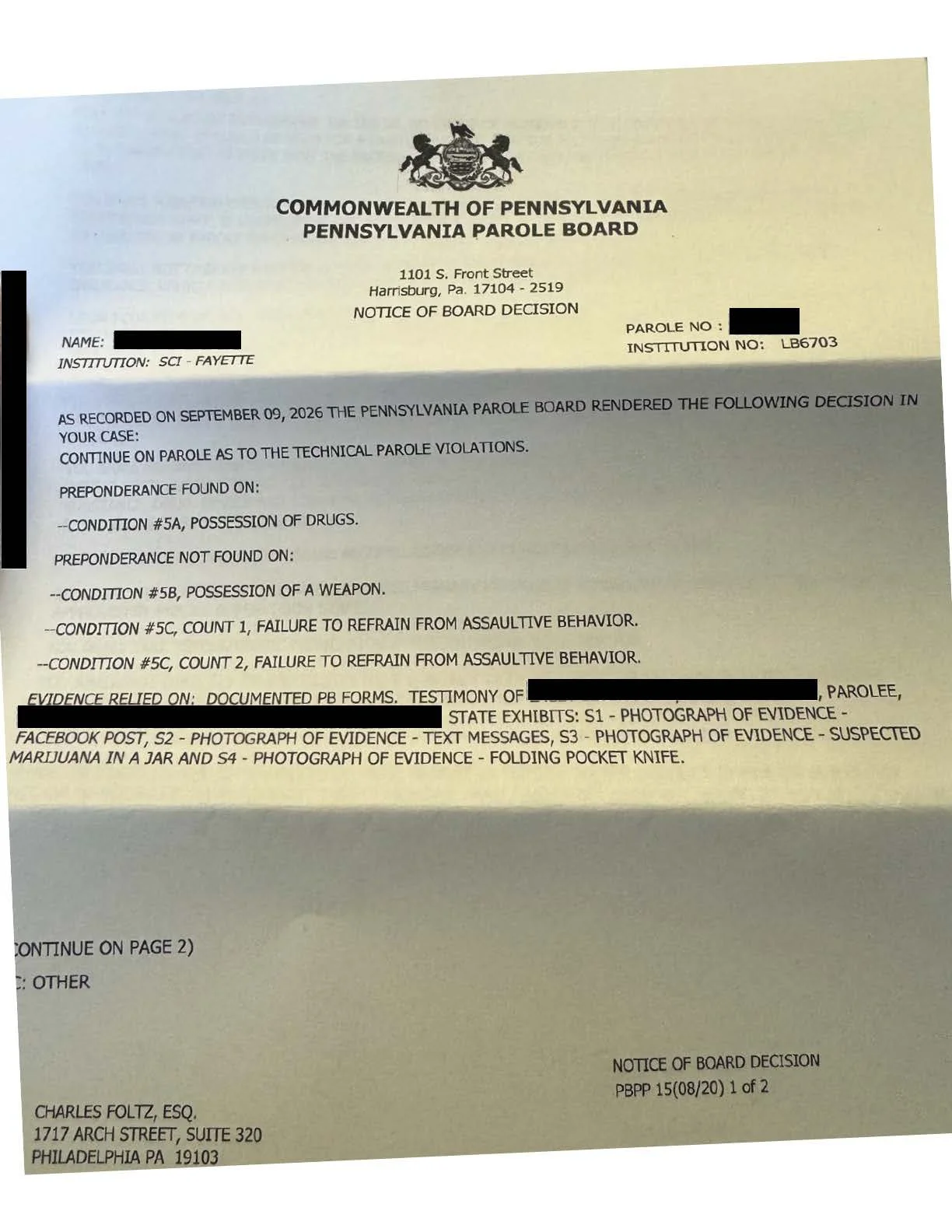
Our client was sitting in a state correctional institution, detained on a Pennsylvania Parole Board warrant and charged with four technical violations of his parole: possession of drugs, possession of a weapon, and two separate counts of failing to refrain from assaultive behavior. Under Pennsylvania law, a technical violation involving assaultive behavior or a weapon can send a parolee back to a state prison. Our client was facing the possibility of being recommitted and losing months of his life behind bars.
When the hearing ended, the Board had rejected three of the four charges, and our client was continued on parole.
What We Did
We got to work immediately. Parole violation cases move quickly, and the hearing can come within weeks of the client’s detention. We met with our client to hear his side of the story, review the charges, and identify the weaknesses in the Commonwealth’s case.
We investigated and gathered evidence. The Board’s case relied on witness testimony, documented parole forms, and photographs, including a social media post, text messages, a jar of suspected marijuana, and a folding pocket knife. We examined each piece of evidence to determine what it actually proved and what it did not.
We kept friends and family involved. Throughout the case, we stayed in constant contact with our client’s friends and family. They were an essential source of information and support, and they helped us build a full picture of who our client is outside of the allegations.
We built a mitigation case. A parole hearing is not only about whether a violation happened. It is also about what should happen next. We gathered mitigation evidence and presented witnesses who testified to our client’s character, his relationships, and his ability to succeed on supervision.
We challenged the evidence and cross-examined the witnesses. At the violation hearing, we held the Commonwealth to its burden of proof. We cross-examined the witnesses against our client and challenged whether the evidence was enough to prove each charge.
The Result
The Board found that the evidence did not establish, by a preponderance of the evidence:
the weapon possession charge;
the first count of assaultive behavior; or
the second count of assaultive behavior.
The Board found a violation on only one charge, possession of drugs. Because of the mitigation evidence we presented, we secured a disposition below the technical parole violator guidelines. Rather than being recommitted, our client was continued on parole and released from custody on his parole detainer.
Defeating the weapon and assault allegations mattered. Those are the kinds of charges that can drive a parolee into state prison and make a short recommitment much longer. By knocking them out and showing the Board who our client really is, we turned a case that looked like a return to prison into a second chance.
Facing a Parole Violation in Pennsylvania?
If you or a loved one has been detained on a parole violation, the hearing is your opportunity to fight back, and what happens before it matters. To learn more about how these cases work, read our guide on Pennsylvania Parole Violations.
Contact our office for a consultation.